When I learned that The National Gallery was going to be holding an exhibition that revolved entirely around the world’s most significant collection of Neo-Impressionist art, I had to plan a visit. I was accompanied to this exhibition not only by my wonderful husband, but also by tea, with my Teapro On-The-Go Tea Flask – Travel Infuser Bottle hand packed with the tea I felt most fitting for this exhibition, Teapro Imperial Shou Mei & Orange Peel White Tea (Imperial Shou Mei white tea from Fuding, Fujian & aged red mandarin orange peels from Xinhui, Guangdong). I picked this tea mostly for aesthetic reasons, because of the way in which the bright orange sections form dots and stripes that break through the brown of the white tea base and look as if I could have cut each cake out of the canvas of one of these Neo-Impressionist paintings.
Most of the paintings exhibited were collected by Helene Kröller-Müller, one of the first great women art patrons of the 20th century, who assembled the most comprehensive ensemble of Neo-Impressionist paintings in the world. Collected with the aim of being publicly accessible, these works now form part of the Kröller-Müller Museum in the Netherlands, which she herself founded.
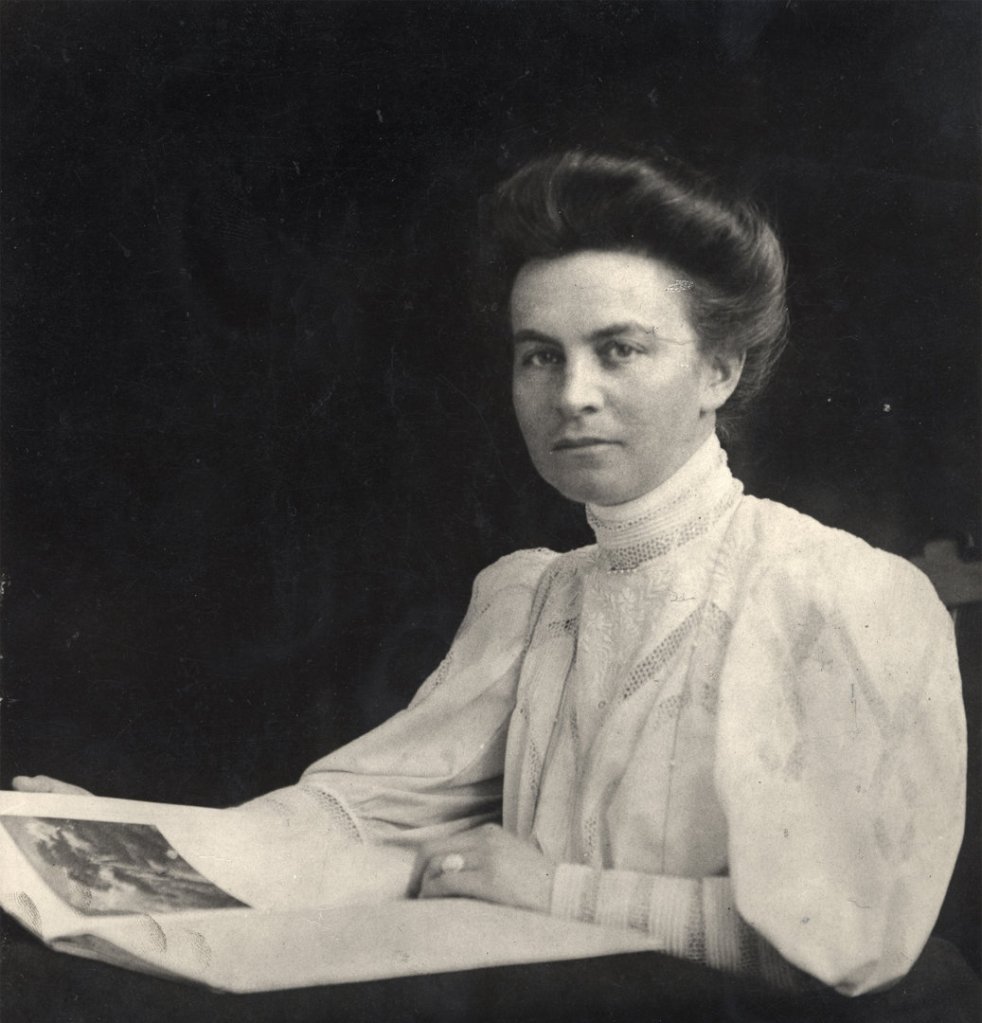
The exhibition was split into the following sections and as I move through this post, I’ll be discussing my highlights.
- The New Art
- Radical Politics
- Portraits
- Seurat’s Chahut
- The Silent Picture
- Light & Spirituality
- Radical Landscape
The New Art
This was the first section of the exhibition and featured on showcasing the development of the Neo-Impressionist movement and, in turn, Pointillism. This section housed many landscape paintings, each capturing beautiful moments in time in a unique way that paved the way for the progression of the movement as a whole. My highlights from this section are Georges Seurat’s – “Port-en-Bessin, A Sunday” (one of six paintings he made of Port-en-Bessin in Normandy during the summer of 1888) & Camille Pissarro’s – “Late Afternoon In Our Meadow” (1887), two very fitting highlights overall, one by a founder of the movement and the other by a key figure of French Impressionism who adopted a looser version of the technique and whose early support of the movement was critical to its establishment. That being said, if I had to pick just one of them, it would have to be Port-en-Bessin.
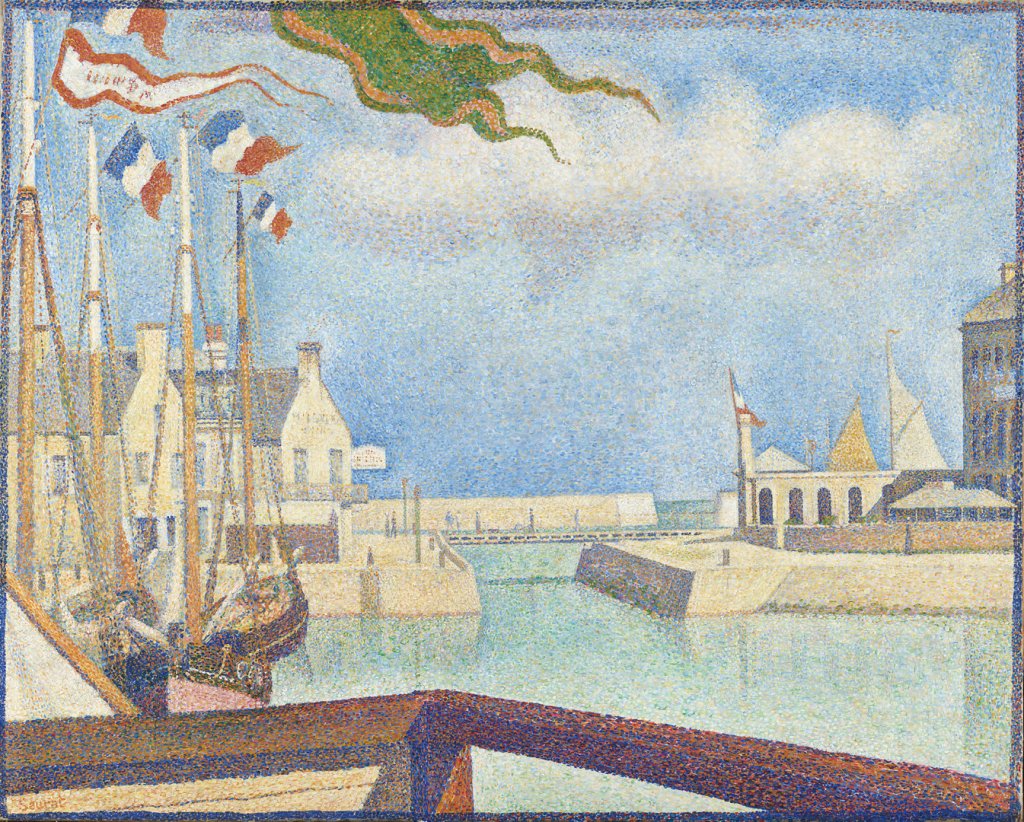
Port-en-Bessin, A Sunday: Could I really have picked any other painting in this section of the exhibition to highlight other than a Seurat? Absolutely not. With that aside however, there are a myriad of other reasons I believe I was drawn to this one primarily. Firstly, the cheerful tranquillity that is encapsulated within it, that you only really ever feel when you are in an environment just like this one, reminded me a lot of the harbour and south bay of Scarborough, which is my favourite seaside town to visit and explore. Its harbour is full of boats both old new, and their flags flutter in the seaside winds all day long; I could watch them endlessly and honestly be at my most relaxed, which is exactly where I was transported to when I saw this painting, like I could have closed my eyes and felt the wind in my hair and the sun on my face & I love when I painting can provide that experience even at first glance.
Radical Politics
In Art, the Neo Impressionist’s political views, opinions & sympathies were often played out through depictions of the everyday lives and landscapes of the people who were perceived to be a part of the exploited class. Some artists, such as Luce, Signac & Jan Toorop, chose to produce work that contained overtly political messaging, while other artists such as Anna Boch & Van Gogh were much less clearly defined in their political commitments. However, they all saw Neo-Impressionism & its aesthetic harmony as being compatible with progressive ideas of the time, & as having a compassionate attitude to the ordinary working people.
My highlights from this section of the exhibition include 4 paintings: Georges Lemmen’s – “Factory on the Thames” (1892), Maximilien Luces’ – “Morning Interior” & “The Iron Foundry”, and finally Vincent Van Gogh’s – “The Sower”, however If I had to pick one, it would be The Iron Foundry.
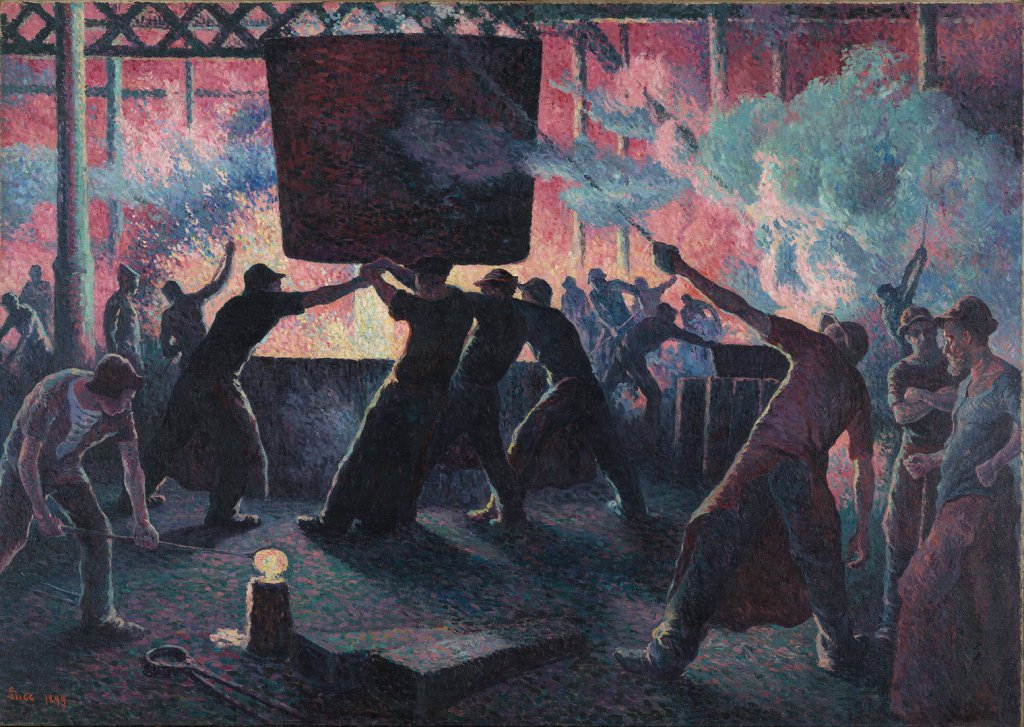
Iron Foundry: Both my husband and I were completely awestruck by this painting from the moment we walked into this section of the exhibition. It focuses on the men’s strength and integrity whilst battling inhumane working conditions of the steel factory, which Luce witnessed himself, in the industrial heartlands of Belgium. They are stunningly backlit by molten metal, working together in an anarchist ideal of creative co-operation, further showcased by the irony of some of the figures enjoying a moment of rest which in reality they never would have been awarded.
It stands out against many works within the entire exhibition because of its dramatic colour palette and how dark it is compared to everything else, with the contrast drawing us in and more being discovered as we got closer and closer. There’s so much action, moment & tension caught within it, especially when you know about the working conditions at the time & what they subjected people to, allowing that idealistic shroud to be lifted from your field of vision.
Portraits
My highlights from this section of the exhibition include (but are not limited to): Theo van Rysselberghe’s – “Anna Boch” & Jan Troorop’s – “Marie Jeannette De Lange”, though if I had to only pick one (as hard as it would be to pick between these two), I think my final choice would be Toorop’s – Marie Jeannette De Lange.
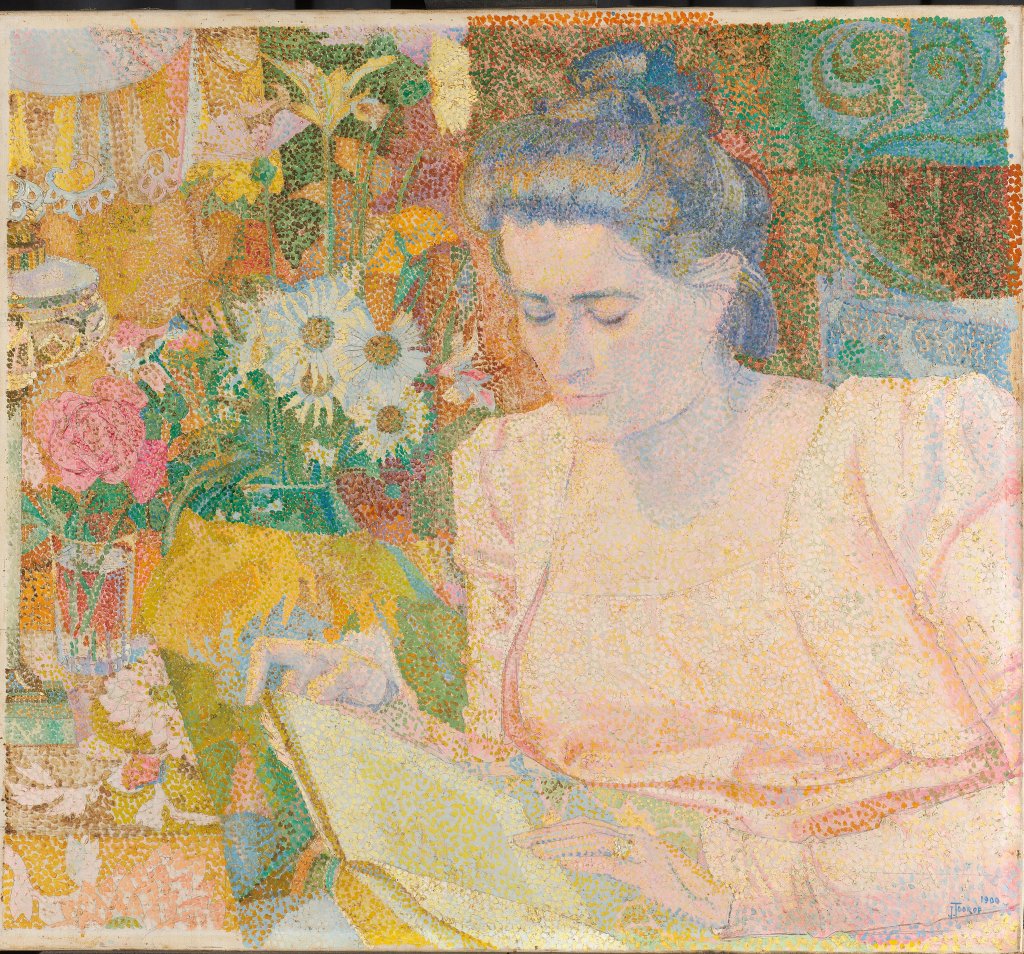
Marie Jeannette De Lange: My theory on why I was so drawn to this painting so wholeheartedly is entirely down to three things, firstly the warm bright saturated colour palette that made it stand apart from many of the other paintings through this exhibition, a lot of which tend to lean into the use of slightly less saturated colour palettes. The warmth and brightness of it really did draw me into it and instantly made me think of summer. Secondly, I was immediately drawn to the face of Marie Jeanette, as the way she is painted instantly brought to mind a very specific photograph of my great grandma when she was young and as soon as I made that connection, I was emotionally connected to this piece, seeing her within it meant so much to me and so incredibly personal given recent circumstances that have been so incredibly emotionally and physically taxing.
Lastly, I loved learning about Marie Jeannette De Lange and her work as the chair of the The Association for the Improvement of Women’s Clothing through this painting. De Lange campaigned for clothes that allowed women healthy and unrestricted movement, just like the reform dress she is wearing in this painting that she wore whilst posing for Toorop for this painting in February of 1900. She was a modern woman on the threshold of a new century and this portrait captures that impeccably.
Seurat’s Chahut
While I loved exploring the work of all of the artists featured within this exhibition, my highlight was definitely Georges Seurat’s – “Chahut”, one of his most important works & one of his ‘toiles de luttes’ (battle canvases), the phrase he himself used to refer to his most provocative manifesto pictures. It was also the last of these paintings he finished before his death in 1891.
This exhibition marked not only the first time this painting had been loaned out since 1958, but also the first time it had ever been on display in the UK. I was immediately able to understand why this particular painting had been chosen as the ‘star feature’ for this exhibition as soon as I laid my eyes upon it. It is truly a masterpiece.
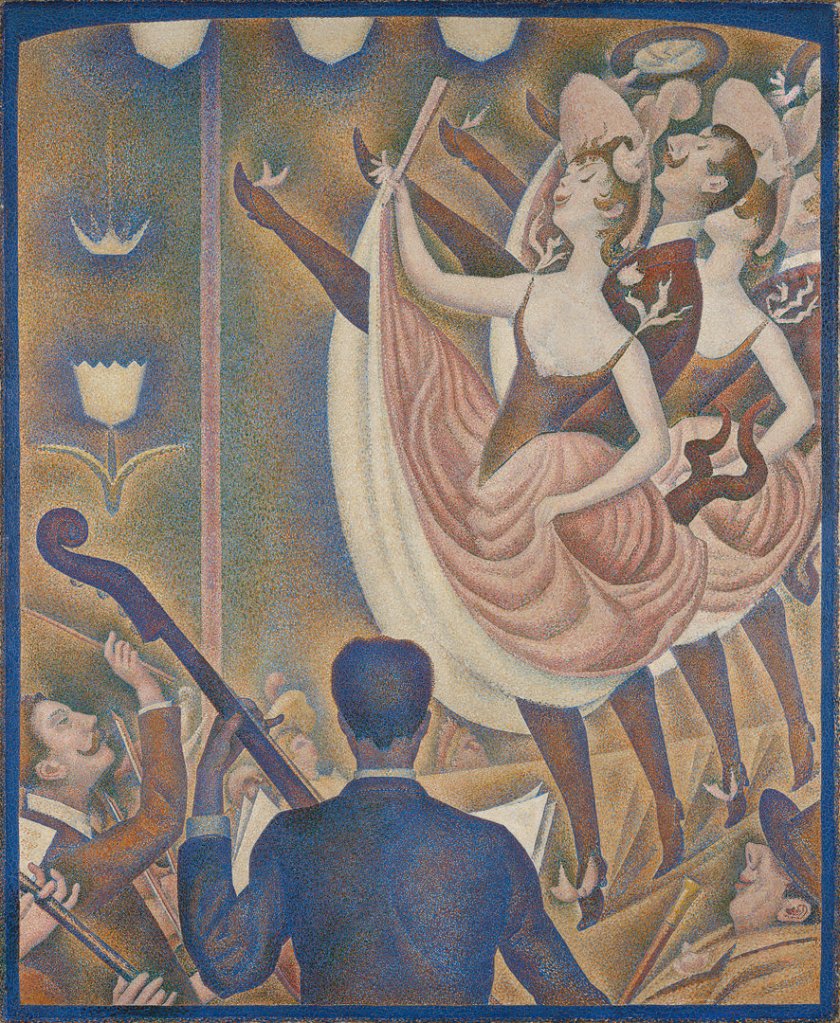
It is a perfect demonstration of Seurat’s theories about how certain colour harmonies and compositional arrangements of lines could convey a particular mood, such as rising lines being meant to express joy. It is an extraordinarily stylised, abstracted and geometrically rigorous depiction of the ‘Chahut’ (or can-can) which was, at the time of painting, the most risqué dance performed in Parisian café-concerts. The harmony of the colours and compositional arrangements create such a unique atmosphere and build mystique, drawing you into the café-concert and allowing you to experience the harmony of the music and dance combining together to create an all encompassing experience.
The Silent Picture
My highlights from this room within this section of the exhibition are as follows: Paul Signacs – “The Dining Room” (Opus 152), Paul Singnac’s – “A Sunday (Opus 201)” & Theo Van Rysselberghe’s – “In July, Before Noon”, all of which are constructed of so many minute dots that when you stand back from the painting, they completely disappear, and it is only as you get closer that they make themselves visible. I spent so long in this room viewing each painting from different angles and distances and was simply awestruck by each and every single of them and the sheer amount of time they would have taken to complete. If I, however, had to pick just one piece from this section it would be Rysselberghe’s – In July, Before Noon.
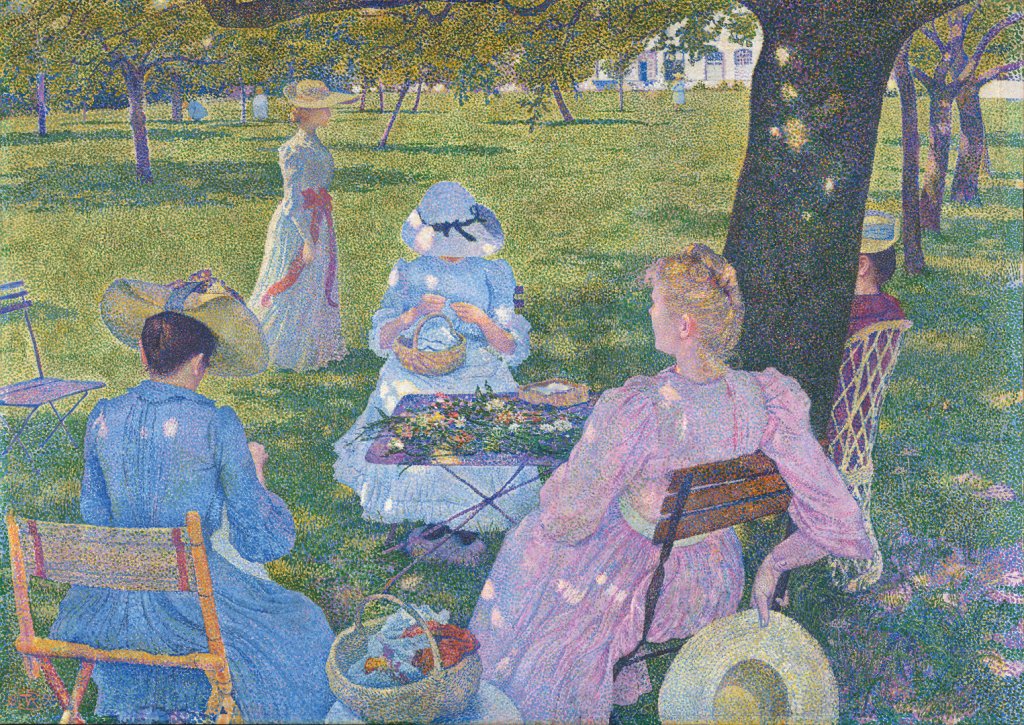
In July, Before Noon: The reasons I picked this piece as my favourite from this section is because of the sheer amount of time I spent admiring it. I was mystified by the way in which light and shadow were depicted within it, as dappled sunlight comes through the leaves and branches of the tree and onto the people below it. Beyond that, the sheer amount of detail achieved within even the smallest elements, for example the flowers on the table, just drew me in and pushed me to allow my eyes to soak in every inch of the canvas to ensure I didn’t miss a single thing. There’s a tranquil energy within this painting, along with a light airiness and a summer morning breeze sweeping through & in that, the essence of this section of the exhibition was encapsulated perfectly.
Light & Spirituality
When describing the first museum she opened, Kroller-Muller was delighted by the contrast created by her room of Van Gogh, which she described in her words as “dramatic & heavy, like hammer blows” and the “light & delicate spiritual” qualities of her Neo-Impressionist paintings. She, alongside many of the artists displayed in this section of the exhibition, believed that it was art’s duty to extract a deeper, spiritual significance from the world of appearances. She hoped that the public would be “moved by these pictures” and their profound sense of peace, along with what she perceived to be their great emotional depth.
My highlight from within this section of the exhibition was Johan Aarts – “Landscape with Dune” (1895).
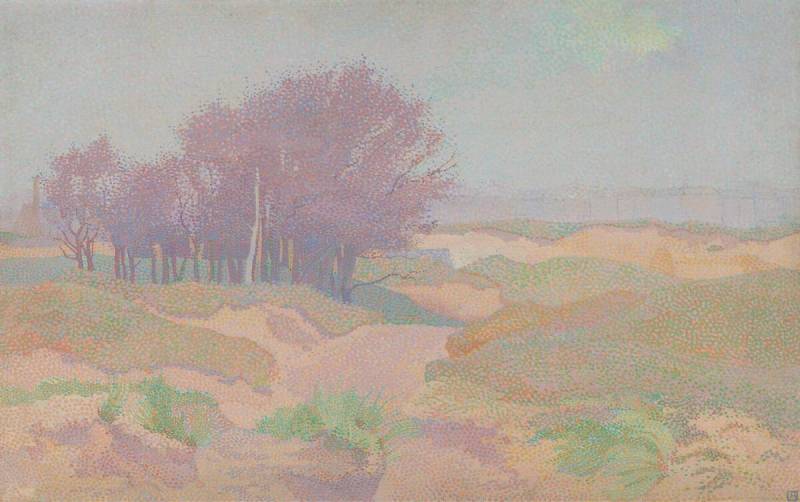
Landscape with Dunes (1895): Similarly to other paintings I have chosen to highlight in this post, I was drawn to this one within this section because of its colour palette, which is as you can see is composed entirely of muted pastels, giving the entire painting a dreamlike ethereal feeling that radiates calmness, stillness and tranquillity. Every aspect of the piece is rendered with intentional, thoughtful simplicity, without an intense amount of detail, yet every characteristic of the environment is immediately recognisable, making the environment feel familiar, as though you have visited before, but this time you are drawn into the tranquil version of it, shrouded in a hazy otherworldly light. It is this profound sense of peace that Kröller-Müller hoped you would find within it, which is instantly showcased and only builds the long you stand before it.
Radical Landscape
My highlights from within this section are predominantly focused on three paintings by Georges Seurat that were all painted in 1890: “The Channel of Gravelines – Grand Fort-Philippe”, “The Channel of Gravelines, Direction of The Sea” & “The Channel of Gravelines – An Evening”, with one additional painting by Jan Toorop titled “In The Dunes Near Domburg” also included, the latter of which would be the one painting I would pick if forced to make that choice. However, with that being said, I want to assure you that the gravitas of the three paintings by Seurat being united for this exhibition was not lost on me.
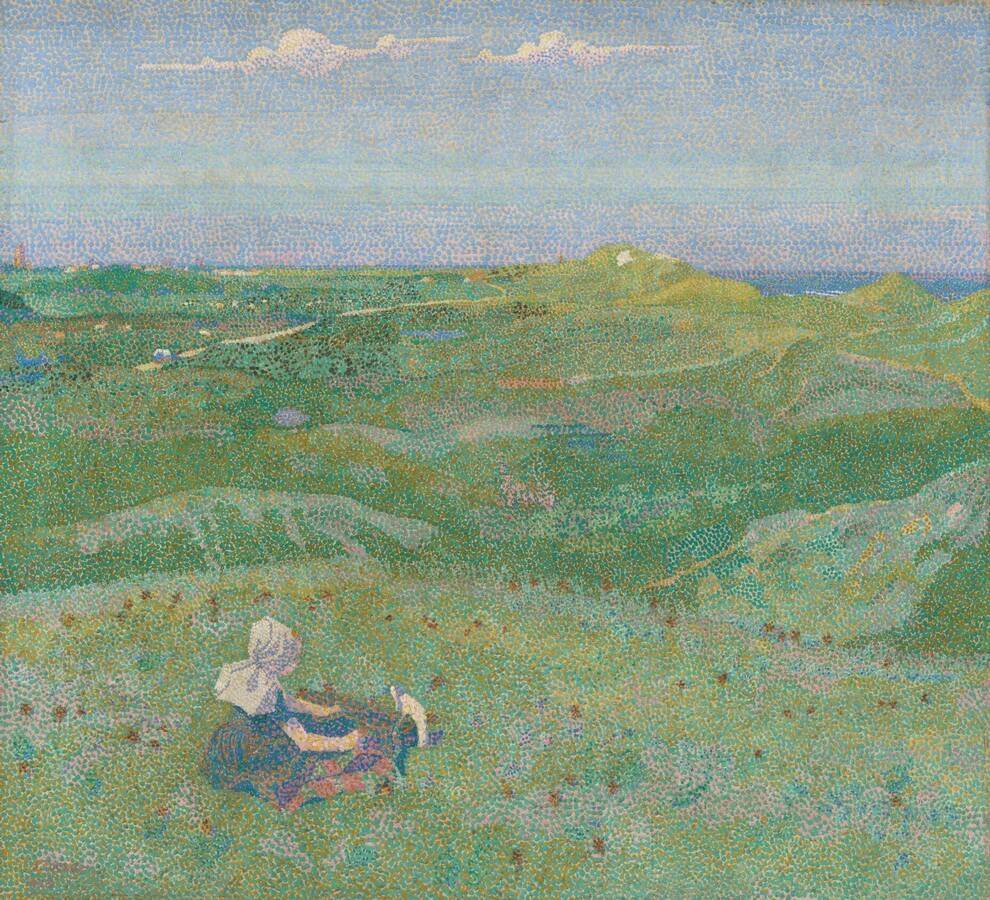
In the Dunes Near Domberg: The main reason I picked this painting was for its texture. As previously mentioned, the time we spent at this exhibition was rather quiet in terms of crowds so we were able to spend extended amounts of time up close and personal with each painting & when you are able to get close to this piece the sheer amount of texture is mind blowing, with each and every single point of paint protruding off of the canvas enough to create their own shadow, making it feel like you could just climb in and sit within the dunes yourself.
I was also, however, drawn to this piece for a few other reasons. The extra fine details in the background of the painting as you move your eyes towards the horizon, with the smallest yet identifiable buildings dotted around the landscape. Alongside that, the atmosphere captured within this piece is calming, yet mysterious. Why is this young girl sitting alone in such a vast environment? Is Toorop trying to convey the environment as being a symbol of insignificance or the morality of mankind, using the girl who sits peacefully within it as a personification of childlike innocence? We will never truly know, but they are the conclusions I am drawn to in my mind, given the context clues provided, such as items of clothing, the time period & also the painter’s personal connection to the environment.
Final Thoughts
As always this was truly and immaculately curated exhibition at The National Gallery and the newly renovated Salisbury Wing was the perfect location for it. I had no doubt in my mind that I was going to be enthralled by this exhibition and seeing so many wonderful works from one of my favourite art movements for the first time, but the team at The National Gallery always manage to blow my expectations out of the water.
Learning about the work that Helene Kröller-Müller did throughout this exhibition and discovering her want to make the art of so many immensely talented artists publicly accessible was incredibly inspiring and despite my well established love for the Neo-Impressionist, I was introduced to a number of different artists for the first time within the walls of this exhibition, and for that I am endlessly thankful.
I can’t wait to find my way back to The National Gallery as soon as possible, to continue to learn & explore.
If you want to find out about the upcoming exhibitions at The National Gallery, you can do that here & if you are able to I urge you to attend as many of them as possible, because they are so well curated and you will leave feeling endlessly inspired by each and every single one, in addition to their incredible collection of art of course.
Should you want to see the accompanying collage I made detailing this exhibition you can find that over on my Instagram @kimberleyskyusu.
Until next time, Happy Steeping – Kimberley


You must be logged in to post a comment.